NCLEX-RN for International Nurses (2026): The Complete US Licensure Roadmap (TruMerit/CGFNS, English Tests, NCLEX, VisaScreen)

If you trained as a nurse outside the United States and want to practice as a Registered Nurse (RN) here, the NCLEX-RN is the exam that stands between you and your U.S. license. The path is very doable — tens of thousands of internationally educated nurses (IENs) go through it every year — but it has more moving parts than it does for U.S. graduates. This is the full 2026 roadmap, end to end.
One number to keep in mind: the first-time NCLEX-RN pass rate for internationally educated nurses is roughly 47%, versus about 87% for U.S.-educated nurses (NCSBN, late 2025). That gap isn't about ability — it's about preparation that fits the U.S. exam style. With the right plan, you can absolutely beat it.
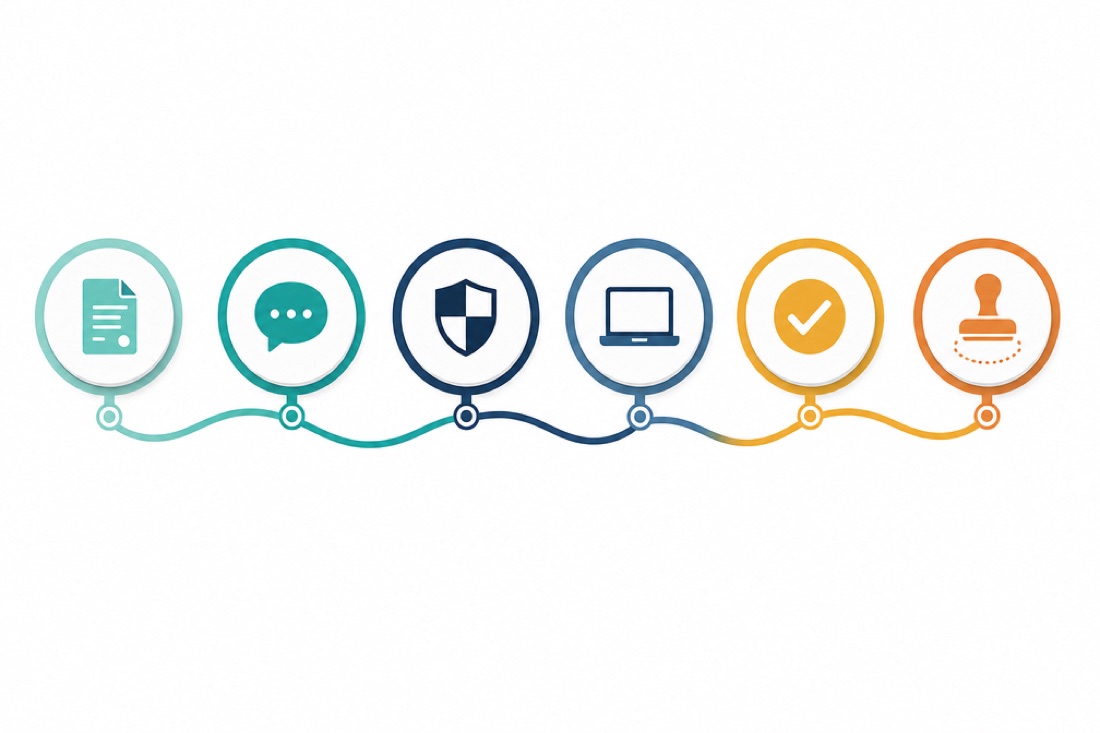
The journey at a glance (6 steps)
- Get your credentials evaluated (TruMerit, formerly CGFNS) to show your education is comparable to a U.S. program.
- Choose your state board of nursing (BON) — requirements vary a lot by state.
- Prove English proficiency (IELTS, OET, PTE, or TOEFL) if your board requires it.
- Apply for licensure with your chosen state BON.
- Register for the NCLEX-RN with Pearson VUE, pay the fee, and receive your Authorization to Test (ATT).
- Pass the NCLEX-RN, then complete any remaining state and (if applicable) immigration steps (VisaScreen, EB-3/TN).
Not sure where you stand on the exam itself? Take our free NCLEX-RN readiness diagnostic to benchmark yourself before you invest months of prep.
Step 1 — Credentials evaluation (TruMerit / CGFNS)
Most states require proof that your nursing education is comparable to a U.S. program. This is done through a credentials evaluation report — most commonly the TruMerit Credentials Evaluation Service (CES) report. (TruMerit is the new name for CGFNS as of 2025 — you'll still see both names everywhere.) You'll typically need:
- Your nursing transcripts and diploma sent directly from your school.
- Verification of your nursing license/registration from your home country.
- Sometimes a VisaScreen certificate (needed later for the immigration/visa step).
Start this early — collecting documents from your school and licensing authority is usually the slowest part of the whole process.
Step 2 — Choose your state board of nursing
You apply for a license in one specific U.S. state, and each state sets its own rules: whether you need a Social Security Number to apply, whether the English test is required or waived, how fast they process applications, and retake rules. The "best" state depends on where you plan to live and work — but the choice matters more than most people realize. We break this down in detail in The Easiest US States for International Nurses to Take the NCLEX.
Step 3 — English proficiency
If your nursing education wasn't conducted in English, most states require an English-language test. Commonly accepted exams (always confirm the exact minimums with your state and TruMerit):
- IELTS Academic — often an overall band around 6.5 with a higher minimum in speaking.
- OET (Occupational English Test — Nursing) — designed for healthcare.
- PTE Academic — accepted by many boards.
- TOEFL iBT — accepted with section minimums.
Some states waive the English test if you trained in a country/program where English was the language of instruction (e.g., UK, Ireland, Australia, Canada [except Quebec], New Zealand). Verify the exact threshold before booking — minimums change, and the right test can save you weeks. See our deep dive: which English test to choose.
Step 4 — Apply for licensure
Submit your licensure application to your chosen state BON, including your TruMerit/CGFNS evaluation and English results. Once the board confirms you're eligible, it notifies Pearson VUE that you may register for the exam.
Step 5 — Register for the NCLEX-RN (Pearson VUE)
Register for the NCLEX-RN through Pearson VUE and pay the exam fee (currently $200 in the U.S., plus any international scheduling fees if you test outside the U.S.). After your board confirms eligibility, you receive your Authorization to Test (ATT) — you must schedule and sit the exam within the ATT validity window.
Step 6 — What the NCLEX-RN tests in 2026
The exam uses the Next Generation NCLEX (NGN) format, which emphasizes clinical judgment over memorization. Expect: stand-alone and multiple-response (SATA) questions, case studies (a 6-step unfolding scenario), and item types like bow-tie, matrix/grid, drop-down (cloze) and drag-and-drop. It's computer-adaptive (between 85 and 150 questions). These formats are the #1 surprise for IENs — practice them until they feel routine.
Realistic timeline & cost (2026)
- Timeline: often 4–9 months end to end, dominated by document-gathering and credentials evaluation. Fast-processing states can shorten this considerably.
- Cost (rough): NCLEX exam $200 + credentials evaluation (a few hundred USD) + English test + state application fee + VisaScreen (if pursuing a visa). Budget several hundred to ~$1,000+ before prep materials. Fees change — confirm current amounts.
Where IENs most often get stuck
- Documents from the home school arrive late — start step 1 first, today.
- Picking the wrong state (e.g., a Social Security Number required at application, or a strict clinical-concurrency rule). Choose deliberately.
- Underestimating the NGN format and U.S.-specific priorities (delegation, patient rights, U.S. drug names and lab units).
- Failing the first attempt and panicking — there's a clear path back. See Failed the NCLEX as an IEN? Retake rules & how to pass next time.
Ready to start?
NCLEX-RN Academy is built specifically for internationally educated nurses — structured training, NGN-style clinical practice, and 1-on-1 mentorship from instructors who've guided foreign nurses to U.S. licensure. See plans and pricing or take the free diagnostic first.
This guide is general information, not legal or immigration advice. Requirements and fees change — always confirm current rules with your state board of nursing, TruMerit (formerly CGFNS), and Pearson VUE. Pass-rate figures are from NCSBN and update regularly.
Frequently asked questions
Do international nurses take the same NCLEX-RN as U.S. nurses?
Yes. There is one NCLEX-RN exam, identical for U.S.-educated and internationally educated nurses. The difference for IENs is the extra steps before the exam — credentials evaluation, English proficiency, and state board eligibility.
Is CGFNS the same as TruMerit?
Yes. CGFNS rebranded to TruMerit in 2025. It still provides the Credentials Evaluation Service (CES) report that most state boards require, and the VisaScreen certificate used in the immigration process. You'll see both names used interchangeably for now.
Which English test do I need for the NCLEX?
Commonly accepted tests are IELTS Academic, OET (Nursing), PTE Academic, and TOEFL iBT. Minimum scores vary by state board, and some states waive the requirement if your nursing program was taught in English. Always confirm the current minimum with your specific state board before booking.
How much does it cost and how long does it take?
The NCLEX-RN exam fee is $200, but the full process also includes credentials evaluation, English testing, the state application, and (for a visa) VisaScreen — often several hundred to over $1,000 USD total. End to end it commonly takes 4–9 months, mostly waiting on documents and evaluation.
Why is the pass rate lower for international nurses?
The first-time pass rate for IENs is around 47% versus about 87% for U.S.-educated nurses. The gap is usually due to unfamiliarity with the U.S. exam style — clinical-judgment (NGN) questions, U.S. drug names and lab units, and U.S. priorities like delegation and patient rights — not a lack of nursing knowledge. Targeted, U.S.-style preparation closes it.
Not sure where you stand?
Take our free NCLEX-RN readiness diagnostic and get an instant estimate of your pass-readiness with a focused study plan.